Winning a job is only the beginning.
Once the customer accepts an estimate, there are materials to order, appointments to organise, costs to record and work to complete.
For many small businesses, those details can quickly become scattered between notebooks, spreadsheets, receipts, messages and memory.
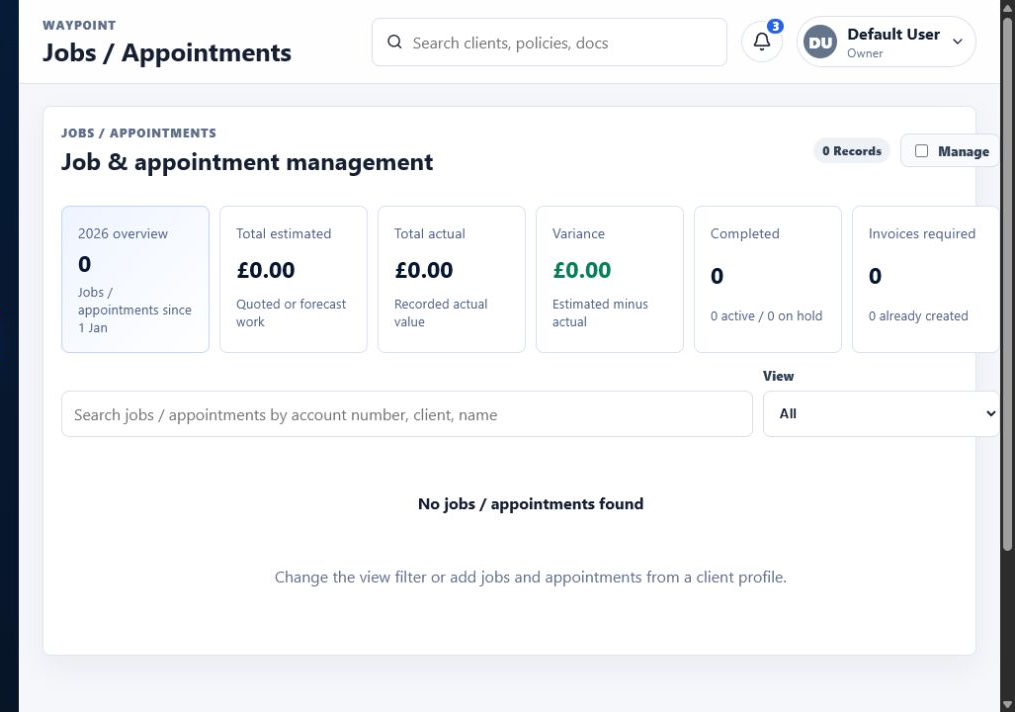
Waypoint’s Jobs area is designed to bring that information together.
Instead of treating a job as little more than a calendar entry, Waypoint gives each piece of work its own record. This helps you understand what is happening, what has already been spent and whether the job is still progressing as expected.
Keep the job connected to the customer
Every job starts with the customer.
By linking a job to the relevant client record, you can keep the work alongside the customer’s wider history instead of creating another disconnected document or spreadsheet.
When a customer calls, you can open their record and see the work associated with them without searching through several different systems.
The job record can hold the practical information needed to manage the work, including:
- The job or appointment details
- Important dates
- The current status
- Notes about the work
- The original estimate
- Costs added while the job progresses
This creates one clear place to return to throughout the life of the job.
Record costs as they happen
A job rarely has only one cost.
Materials may be purchased from several suppliers. Equipment might need to be hired. Waste may need to be removed. A subcontractor could be brought in for part of the work.
Waypoint allows individual costs to be added to the job as they occur.
For example, a job might include:
- £1,450 in materials
- £600 for subcontracted work
- £180 for equipment hire
- £90 for waste disposal
Rather than keeping those figures on separate receipts or attempting to reconstruct them later, each cost can be recorded against the job itself.
The total recorded cost in this example would be £2,320.
That figure can then be viewed against the estimate recorded for the job.
Compare the running cost with the original estimate
An estimate is useful when the work begins, but it becomes far more valuable when you can compare it with what is actually happening.
As new costs are added, Waypoint keeps them connected to the job and provides a running total.
This gives you a clearer indication of whether the work remains within expectations.
Suppose a job was originally estimated at £4,800 and £2,320 of costs have currently been recorded.
You can see that position while the job is still active instead of discovering it after everything has been completed.
This does not replace proper bookkeeping or final accounting. It provides an operational view of the job while there is still time to act.
You may notice that:
- Material prices were higher than expected
- Additional work has been requested
- More labour is required
- Equipment hire is taking longer than planned
- A cost was missed from the original estimate
Seeing that information during the job allows you to make better decisions and have earlier conversations with the customer where necessary.
Stop relying on memory
Many experienced tradespeople can keep an impressive amount of information in their heads.
The problem is that memory becomes less reliable as the number of customers and active jobs grows.
Even when the work itself is managed well, it is easy to lose sight of a receipt, forget an additional purchase or underestimate how several smaller costs have accumulated.
Recording each cost against the job creates a reliable history.
That history can also help when estimating similar work in the future. Instead of relying entirely on what you remember, you can refer to what previous jobs actually involved.
See the wider customer picture
The job does not exist in isolation.
Because it is connected to the client, it forms part of a wider customer record that can also contain notes, documents, tasks and other activity.
This is particularly useful when a customer returns with a question or requests more work.
Rather than asking someone to explain the entire history again, you can open the customer record and see what has already happened.
The aim is simple: when a customer contacts your business, the information needed to help them should already be available.
Move from active work to completion
As the work progresses, the job status can be updated so it is clear what is upcoming, currently in progress or completed.
Once the work has been finished, the job record remains as a useful history of:
- What the customer requested
- What work was completed
- What costs were recorded
- What the original estimate was
- What happened throughout the job
Where an invoice is required, the information already stored against the job can support the next administrative step without starting again from an empty record.
Job management without unnecessary complexity
Waypoint is not trying to turn every tradesperson into an accountant or project manager.
The Jobs area is intended to provide a straightforward way to organise work and retain the information that matters.
For a sole trader, that could mean keeping control as the number of customers grows.
For a small team, it could mean giving everyone a clearer understanding of what has been booked, what is happening and what still needs attention.
The objective is not to add more administration.
It is to prevent important details from becoming scattered across several different places.
A clearer view of every job
A completed job should tell you more than whether the work was finished.
It should show what was expected, what happened and what it cost along the way.
By keeping the customer, job details, estimate and individual costs together, Waypoint gives small businesses a clearer view of their work while it is still happening.
That means fewer surprises, better records and more useful information for the next job.
Frequently asked questions
Can I record several different costs against one job?
Yes. Individual costs can be added to the relevant job as the work progresses, allowing the running total to build over time.
Can I compare job costs with my estimate?
Waypoint keeps the costs recorded against the job alongside the original estimate, helping you understand how the work is progressing financially.
Is Waypoint an accounting package?
Waypoint is a business management platform rather than a replacement for professional bookkeeping or accounting software. Its Jobs area provides an operational view of the work and its associated costs.
Can a job be linked to a customer?
Yes. Jobs are linked to client records so work can be viewed alongside the customer’s other information and history.