Most businesses do not deliberately create complicated processes.
The complexity builds gradually.
A new enquiry arrives by email. Notes are written somewhere else. A quote is created from a template. Documents are saved into a folder. Work is tracked on a spreadsheet. An invoice is raised in another system, and somebody must remember how everything relates.
Each individual step may work, but the business spends more and more time connecting them.
That is why Waypoint is built around a client-first approach.
Instead of treating clients, Work, documents and finances as separate pieces of administration, Waypoint connects them around the relationship at the centre of the business: the client.
What does client-first actually mean?
Client-first means that when you need to understand what is happening, you begin with the client or customer.
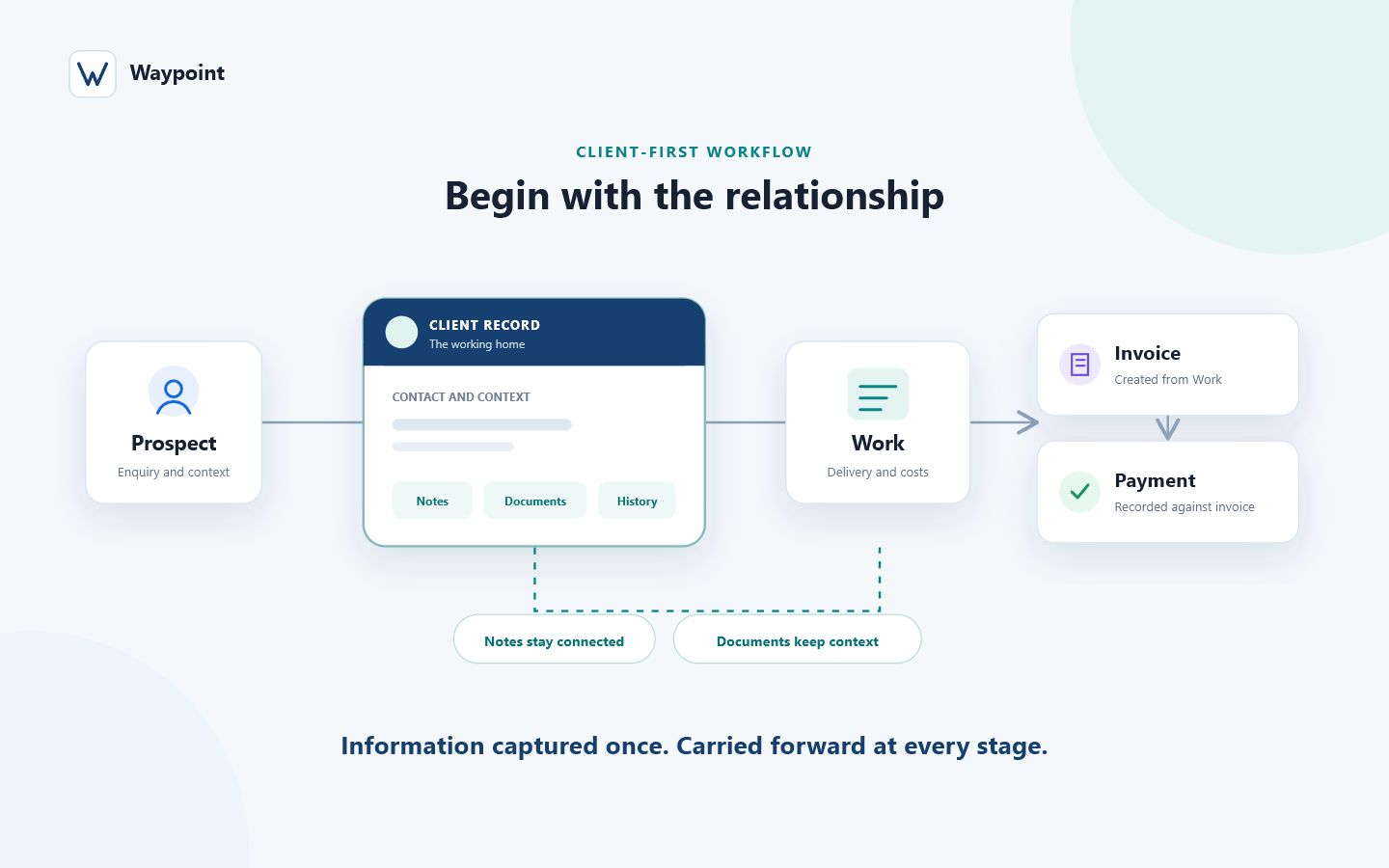
From there, you can see the information connected to that relationship: the original opportunity, important notes, documents, ongoing Work, costs, invoices and payments.
You should not need to remember which spreadsheet contains the job, search through several folders for a document or open another record to check whether an invoice has been paid.
The client becomes the route into the whole story.
This may sound like a small change, but it creates a very different way of working. Information is captured once and then carried forward as the relationship develops.
See the wider Waypoint platform areas that keep customers, Work, records and money connected.
The client record becomes the working home
Waypoint supports this approach by making the client or customer record the working home for that relationship.
Rather than creating Work, uploading documents or recording notes in disconnected areas and attempting to link everything afterwards, users begin inside the client record and create what they need from there.
Notes, Work and documents are therefore connected to the correct client from the moment they are created. Where the workspace uses policies, those can begin from the client record too.
This is an important distinction.
Waypoint does not simply provide a screen where users can eventually view related information. It encourages them to build the client’s journey from one place, so the connection exists naturally rather than relying on somebody remembering to create it later.
The client record becomes both the starting point and the continuing source of context for everything the business does with that customer.
The journey begins before somebody becomes a client
Every client begins somewhere.
They may submit an enquiry, call the business, ask for a quotation or be introduced through a recommendation. At that stage, they are still a prospect—but the information being collected already matters.
Waypoint provides a place to keep that opportunity together with its contact information, notes and documents.
If the prospect decides to go ahead, the existing record can be converted directly into a client. The information already collected moves forward with them.
There is no need to create a second record, copy notes into a different area or move documents manually. The history of how the relationship began remains available.
The business can continue from the point it has already reached.
Read how Waypoint converts a successful prospect into a client without rebuilding the record.
From client to Work—without rebuilding the context
Once somebody becomes a client, the next step is usually the Work itself.
In disconnected systems, this often means entering the same name, address and contact information again, creating another folder and explaining the job from the beginning.
In Waypoint, users create the Work directly from within the client record. That means the relationship between the client and the Work is established immediately.
The business can see what is being delivered, when it is due, the costs involved, the documents attached to it and its current position.
If the client returns for further Work, the new activity becomes part of the same continuing relationship rather than another isolated record.
That creates a clearer picture for the person completing the Work, the person handling the administration and the business owner trying to understand what is happening.
Everybody begins with the same context.
Explore how Waypoint keeps Work, itemised costs, documents and invoicing connected.
Documents stay with the reason they exist
A document is rarely useful in isolation.
It normally belongs to a prospect, a client or a particular piece of Work. When documents are stored without that context, filenames and folder structures have to do all the explaining.
Waypoint allows documents to remain connected to the record they relate to.
That could include an initial brief collected while somebody was still a prospect, supporting information held against the client or paperwork produced while completing the Work.
Because documents can be added from within the relevant client or Work record, users do not have to upload them somewhere else and then remember how they should be connected.
Instead of asking, “Where was that file saved?”, the user can begin with the client or the Work and find the document where it belongs.
The financial position follows the Work
The client-first approach does not stop when the Work is completed.
Waypoint connects the operational side of the business with its financial position. Work can carry itemised costs and, when invoice-required Work is completed, Waypoint can create the connected invoice. Payments are recorded against that invoice, while Company Finance brings the individual records together into a wider view.
This helps a business understand:
- What has been invoiced
- What has been paid
- What remains outstanding
- Which invoices are overdue
- Which completed Work is still awaiting an invoice
- What the Work has cost to deliver
The numbers are not detached from the activity that created them. A business can move from its overall financial position back to the client and Work behind it.
That connection makes the information easier to understand and far easier to act upon.
See how Company Finance connects invoices, payments and outstanding balances to the Work behind them.
Where the time is really saved
The biggest time savings rarely come from one dramatic button.
They come from removing the small repeated tasks that happen throughout the day:
- Re-entering contact details
- Copying notes between records
- Downloading and uploading the same documents
- Creating duplicate client folders
- Searching email chains for previous conversations
- Checking separate spreadsheets for Work and payment information
- Asking another team member for an update
- Reconstructing what happened when a client returns
- Correcting information that was copied incorrectly
- Trying to work out which record is the latest version
Each interruption may only consume a few minutes. Repeated across every enquiry, client, piece of Work and invoice, those minutes become hours of administration.
The business is not working faster because people are being asked to rush. It is working faster because they are no longer repeating Work that has already been done.
Less searching also means fewer mistakes
Time is only part of the benefit.
When information is copied between spreadsheets, folders and systems, inconsistencies appear. An address is updated in one place but not another. A document is attached to the wrong record. An old figure is used for an invoice. Two people unknowingly create separate versions of the same information.
Creating related activity from within the client record reduces the number of opportunities for these disconnections to occur.
The relationship is established at the beginning, rather than depending on somebody remembering to repair it afterwards.
It also makes responsibility clearer. A team member can see the current information and the Work associated with it without depending entirely on somebody else’s memory.
That becomes increasingly important as a business grows. Processes that feel manageable for one person can quickly become fragile when several people need to understand the same client.
A clearer experience for the client
Although the client-first approach improves internal organisation, the client benefits too.
They do not have to repeat information they have already provided. Questions can be answered more quickly. Previous Work is easier to understand. Documents are less likely to be misplaced, and the business can respond with better context.
The client experiences a business that appears organised and remembers the relationship.
Behind the scenes, that experience is created by something straightforward: beginning with the client and keeping the information connected.
Built from real feedback
The importance of this approach became even clearer during Waypoint’s initial testing.
People did not simply ask for more features. Much of the most valuable feedback concerned clarity: understanding where to begin, how different areas related to each other and what should happen next.
That feedback reinforced the direction of Waypoint.
The answer was not to create more isolated screens. It was to make the client record the natural starting point and strengthen the connections between prospects, clients, Work, documents and finances.
Prospects become clients. Clients require Work. Work creates costs, documents and invoices. Invoices receive payments.
Each stage should continue naturally into the next.
The Waypoint product updates record how that client-first direction has been brought into the live platform.
One connected view of the business
Waypoint’s client-first approach is not about forcing every business into an identical process.
It is about providing a clear foundation: begin with the client, capture information once, create what you need from within their record and keep the complete journey connected.
For a business owner, that means less time spent piecing together what is happening and more time available for clients, staff and the Work that moves the business forward.
For a team, it means clearer handovers and less dependence on information held in one person’s head.
For the client, it means dealing with a business that already understands who they are and what has happened before.
That is the approach at the core of Waypoint:
Start with the client. Build from their record. Keep their journey connected. Let everything else follow.
Frequently asked questions
What does client-first business management mean?
It means using the client record as the working home for the relationship. Notes, Work, documents and other relevant activity begin from or remain connected to that record, so the business can understand the complete journey in context.
Can a prospect become a client without re-entering their information?
Yes. A successful prospect can be converted into a client while retaining the contact information, notes, documents and history already collected.
Is an invoice created directly from the client record?
Invoices are created from completed Work that has been marked as requiring an invoice. Because the Work already belongs to the client, the resulting invoice remains connected to both the customer and the activity that generated it.
How does Company Finance fit into the client-first approach?
Company Finance brings together invoiced, paid, outstanding and overdue amounts while retaining routes back to the relevant clients, invoices and Work.
Does client-first mean every business must use the same process?
No. It provides a clear connected foundation while allowing Work to represent the jobs, projects, appointments, cases, reviews or services that make sense for the business.